
I started to understand the meaning of feedback in recent years — feedback is a gift. Every year, I collect feedback, either through a formal process led by my managers before performance evaluations or when I actively sought it for my own development.
This year, as part of the Leadership for Leaders training, I collected feedback again and reflected on the results.
Why was feedback a gift?
I had also given feedback to many people when asked, and I realized it was not an easy task. That’s why I deeply appreciated every single person who took the time to give me their feedback. It wasn’t easy to give feedback that was both encouraging and constructive for someone’s growth.

The Pattern
From the survey results, I noticed a pattern.
No matter how self-aware I tried to be, feedback was a powerful tool because it revealed patterns more clearly.
The more consistent of the feedback, the more I could see the alignment in my leadership, communication, listening, and relationship-building skills. Positive feedback like this encouraged me to continue what I was doing.
Similarly, patterns also appeared in areas for improvement.
One common comment I received again was about my speed — how quick and fast I was. This wasn’t the first time I had heard this feedback or reflected on it. Even though I felt like I had already slowed down compared to before, I realized I was still naturally quick.
Luckily, during a Leadership for Leaders pairing session, I was matched with a colleague whom I described as having a warm, fatherly presence. I shared this feedback with him, and he offered a new perspective (my secret) :”>
Then how to maintain my quick pace while still giving others space and time to contribute and reflect — balancing the team’s rhythm, not just my own.
1. What Made Me Proud?
One thing that made me proud was that people evaluated me more positively than I evaluated myself.
Especially when it came to IKEA values — Leading by Example was the value I treasured the most and aimed to embody.
Fortunately, many pieces of feedback mentioned this specifically.
It made me genuinely happy and proud that my actions aligned with what I aspired to be.
For me, “walking the talk” was very important.
I was more of a doer than a talker. I believed that my actions should reflect the values I stood for, rather than just saying nice words.
I was so grateful that others could see this in me.
2. What Made Me Uncomfortable?
It wasn’t exactly discomfort — it was more disappointment and sadness.
One personal value that meant a lot to me was compassion and empathy. I really wanted to be seen as an empathetic person.
However, not everyone perceived me that way.
I wasn’t aiming for perfection or to please everyone, but I deeply appreciated this feedback.
Maybe sometimes, in my eagerness to find solutions and achieve results, I missed how others were feeling along the way.
Before reaching out to ask for more detailed feedback, I wanted to first practice more conscious reflection — to work on improving myself and see if I could notice the change, both in my own feelings and in how others experienced me.
Other Lessons from Collecting Feedback
- Everyone had a different scoring system:
Sometimes, I assumed that if someone gave constructive feedback, they would score me low (like a 6 or 7 out of 10), but then the score was actually a 9.
This taught me not to prejudge the results based on the numbers alone — it was more important to focus on the content of the feedback.
- Feedback vs. Feedforward:
Only recently had I learned the difference between these two terms.
I believed both were valuable for growth. In the Leadership for Leaders feedback form, there was not only feedback on the past but also suggestions for the future — a combination of feedback and feedforward.
Feedback helped build awareness and sparked immediate improvement.
Feedforward focused on what I could do next to get even better.
For me, it wasn’t so much about whether it was feedback or feedforward — it was about how to use the insights to reflect and build a personal development plan.
Here’s a simple comparison from ChatGPT:
| Feedback | Feedforward | |
| Time | Past | Future |
| Tone | Often evaluative | More positive and supportive |
| Focus | What happened | What can happen |
| Goal | Awareness | Improvement |
Thanks to everyone who gave me feedback, and to those who asked for my feedback too.
I hope we all continued to stay conscious of what we were doing.
I believed journaling really helped — especially for people like me, who often had a lot of thoughts running through their minds.
Journaling and writing helped me organize my thoughts more clearly.
Thanks also to the Leadership for Leaders training, which reminded me again about the importance of reflection through journaling.
Thank you.
*Updated 25th May 2025
Thank you for all the lessons during the past two months in the Leadership for Leaders training.
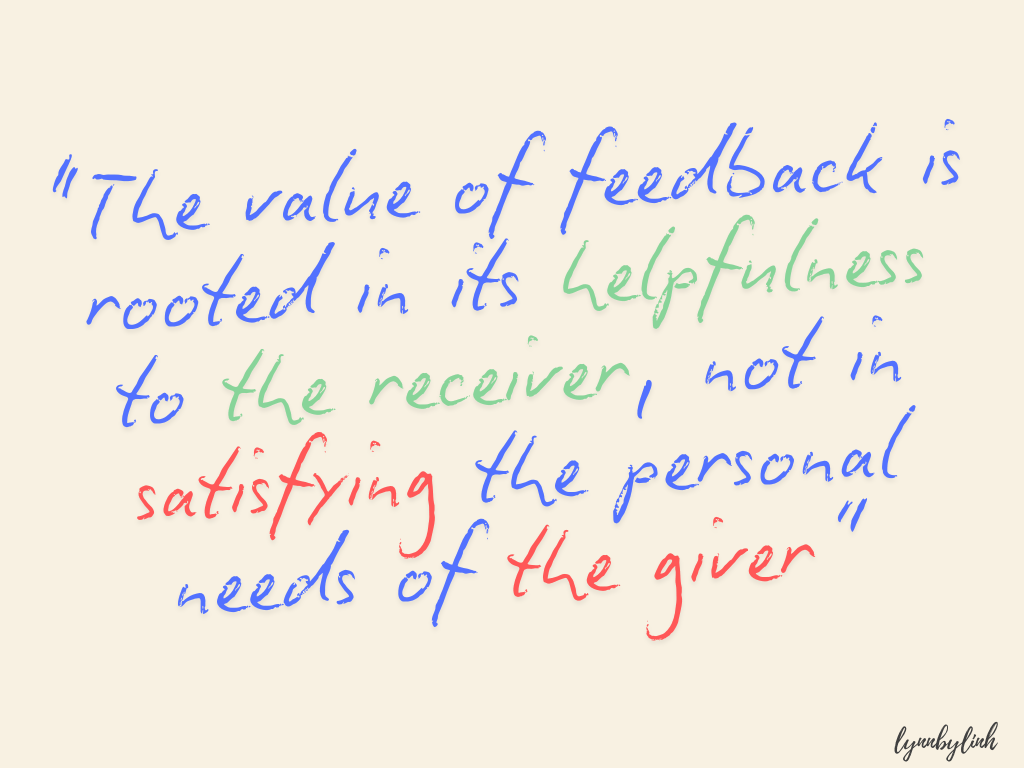
In our final session, the facilitator shared a quote: “Feedback should be of value for the receiver, not relief for the giver.”
It’s not exactly the same as the quote in my picture, but its meaning truly resonates and will stay with me.



 Lynn By Linh
Leave a comment