
Sharpern your message & make your words matter
Sometimes my thoughts are tangled, and my speech doesn’t know where to start or end. But this is a simple yet inspiring book that reminded me how important it is to find and deliver my point clearly and directly. I’m still learning — trying to make it a little better each time I speak or present.
It made me realize that every time we communicate, we’re hoping to do something or move someone — and to make a point, we first need to have one.
In this book, not every tip fits me perfectly, but overall, it’s a gentle and practical guide to communicating with more clarity and purpose.

The book has 11 short chapters, so while reading, you can practice at the same time and see how much difference it can make. I can say this is a very practical book for articles, presentations, speaking, etc.
- The Big Flaw — Identifies the common communication problem: people often lack a clear point.
- Know Your Point — How to define a real point that can be argued and defended.
- Make Your Point — Techniques for actually conveying your point to others.
- Sell Your Point — How to “sell” your idea instead of just sharing information.
- Tailor Your Point — Know your audience to tailor and customize your point, including information, insight, news or updates, inspiration, appreciation, empathy, explanation, comfort.
- Stay on Point — You can bring up your point a few times, but ensure that you only have one point, and clearly state it: “My point is this…”.
- Strengthen Your Point — Tools to reinforce your message, such as pausing, adjusting volume, and combining psychological and physical involvement or interaction.
- Complete Your Point — Concluding strongly and ensuring your message lands.
- Five Enemies of Your Point — Common things that undermine communication impact.
- #1 “And” — More is less. We don’t always need the word “and”; ending your point earlier makes it sharper and helps you focus on one thing at a time.
- #2 Nonsense words — “uhm,” “ah,” “so,” etc.
- #3 All apologies — This is one point I didn’t fully agree with. The writer mentions that we shouldn’t say how nervous we are, but I think being authentic and vulnerable about feeling nervous is also a way to communicate.
- #4 Speed — Control your speed and volume.
- #5 The Department of Homeland Insecurity — This is an important enemy because “it’s not public speaking people fear; it’s public humiliation.” This is so true.
- Cases in Point — Applying the concepts to real scenarios (speeches, PowerPoints, emails, etc.). In this chapter, there are checklists you can go through to see whether you truly “get to the point.”
I try to go through this book before preparing for a presentation or speech, to make it structured and get to the point I want to deliver.
To close this review, the writer mentions a popular quote:
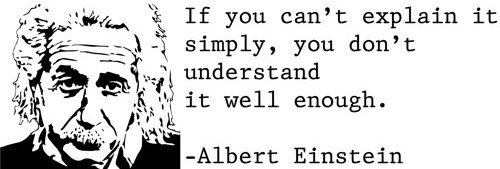
“If you can’t explain it simply, you don’t understand it well enough.” — Albert Einstein
Thank you.



 Lynn By Linh
Leave a comment